21 Jun 2025 – 1:00pm
[in person at The 1912 Gallery, Sunny Bank Mills]
event transcript
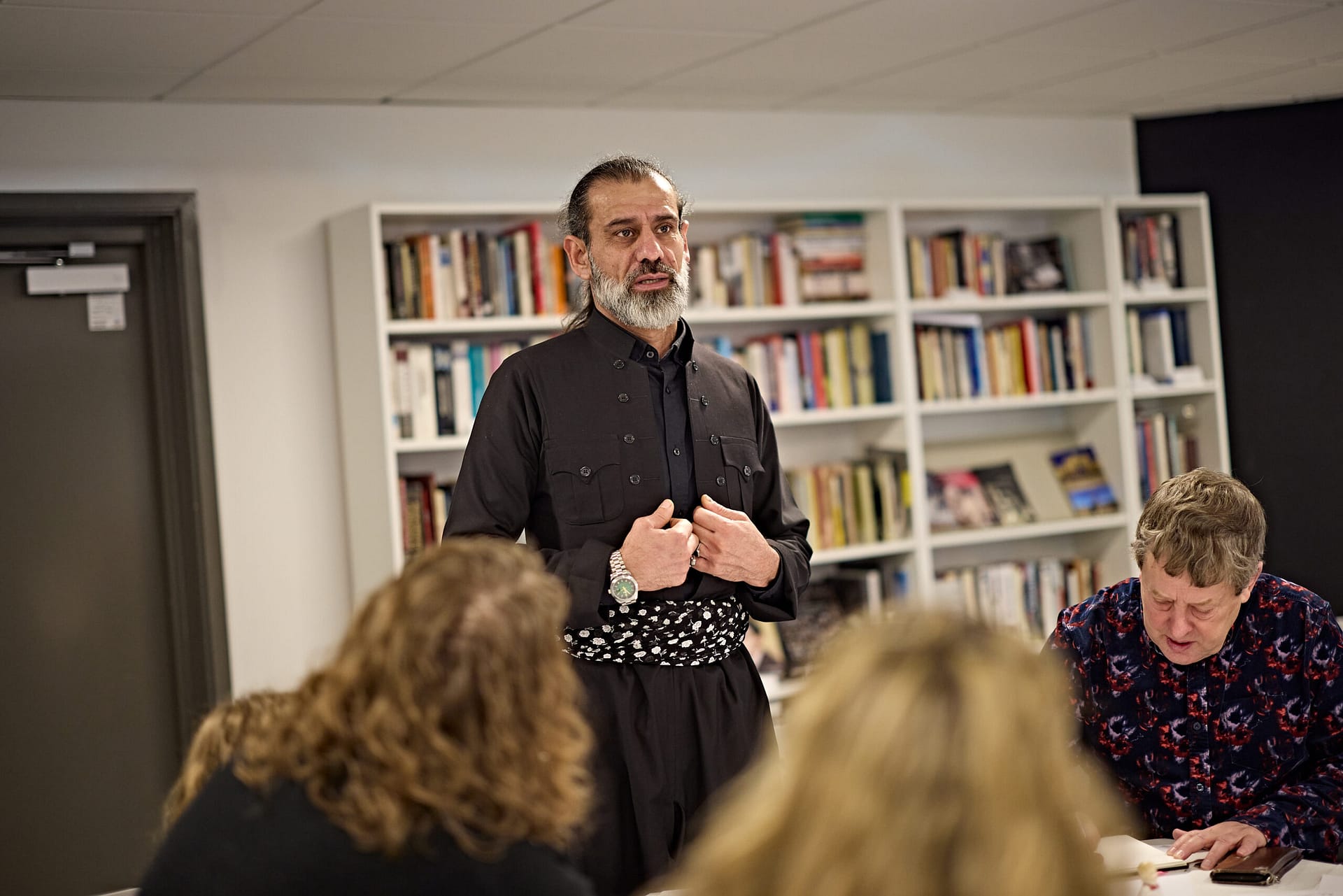
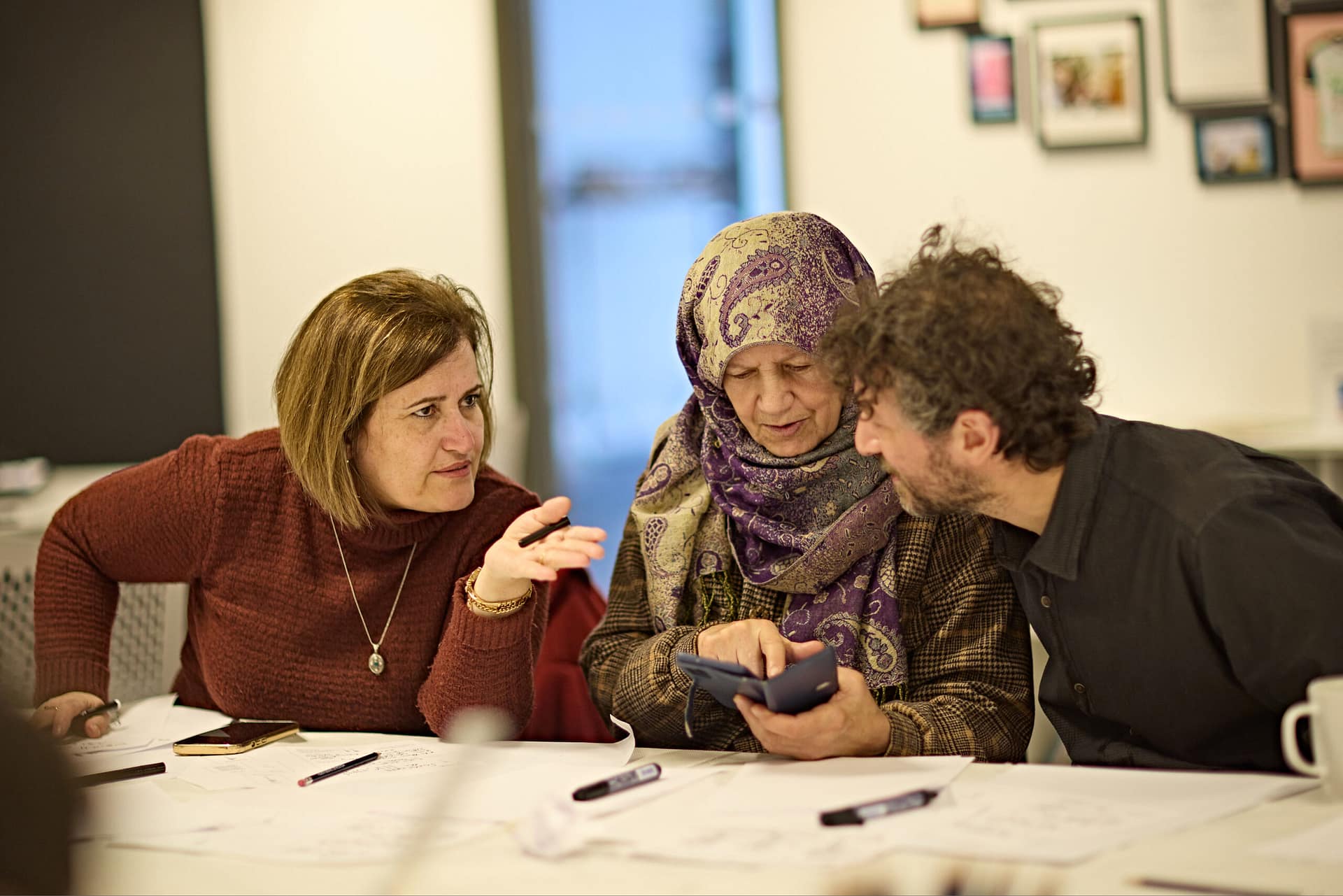
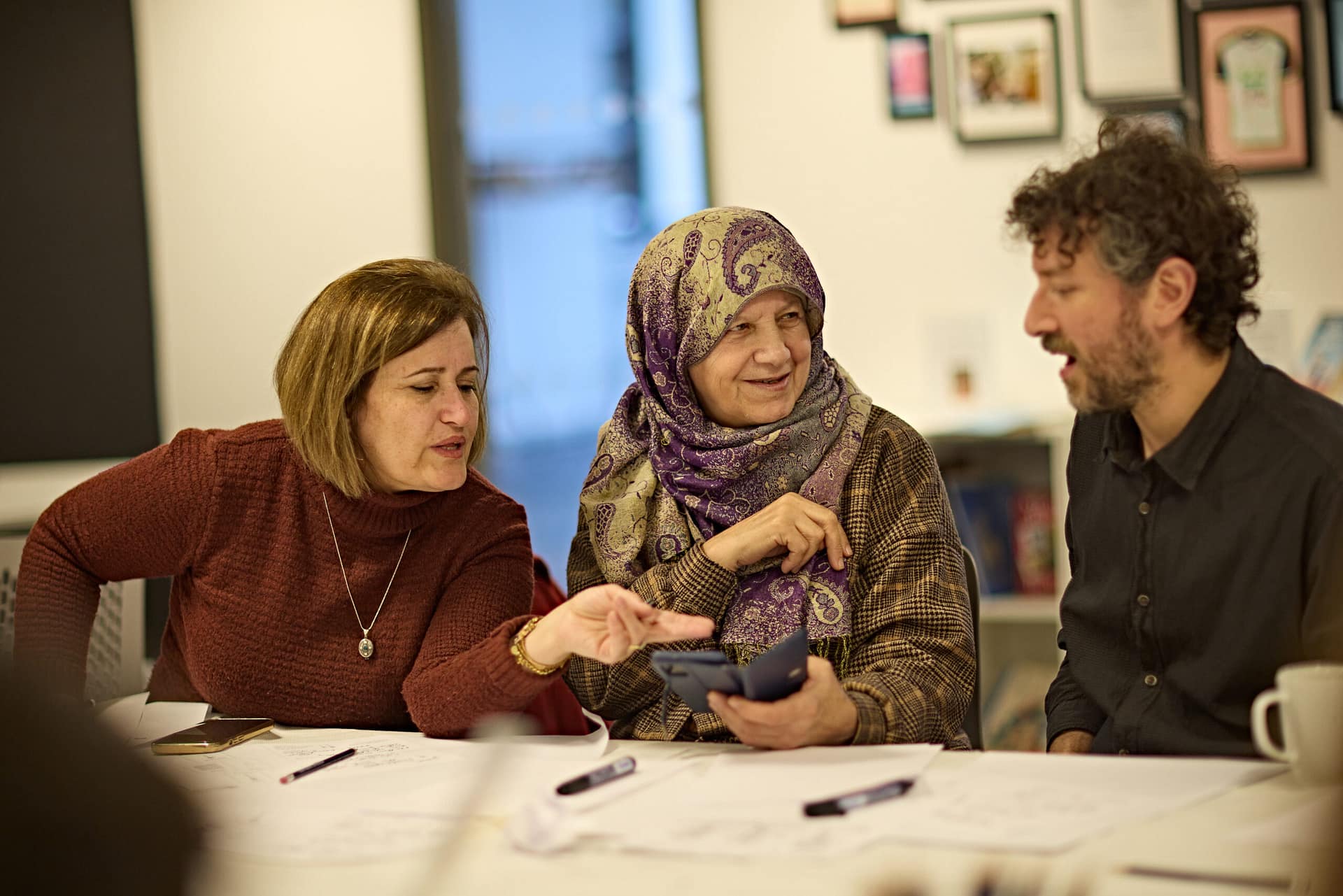
GT: Welcome to Memorial Gestures at Sunnybank Mills at the beautiful 1912 Mill. My name is Greg Thorpe. I’m the Head of Creative Programming at Holocaust Centre North. This is the first project that I’ve been involved with at the centre. I joined at the end of January. So, this whole experience has been my way of getting to know the centre, of getting to know the archive and the artists. So, it’s been a real baptism of fire and a fascinating one at that.
Hopefully, you’ve had time to engage a little bit with the show. Please do stay and experience it more, or again after the conversation. You might notice things; you might feel things differently or understand things slightly differently.
I’d like to draw your attention to the text on the window. It’s a piece that some visitors might miss. They’re on the panes of glass on both sides of the room, translations into English of letters that we hold in the archive at Holocaust Centre North. Also, we invite you to take a piece of the writing on the table here. That’s a work you can take away with you and read at your leisure. It’s part of a work in progress by one of our writers in residence, so just to make sure you don’t miss any of the finer points.
Our funders and ourselves really appreciate understanding how our work lands and how it reaches people. So, there’s response forms that we’d invite you to fill in. It really, really helps us to get to make the next thing possible in terms of funding, so please do fill a form in on the way out, and our funders will adore us even more.
There is another conversation event on Wednesday evening, which will be with Laura Nathan. Laura’s work is in the installation in the far corner. Laura’s a fascinating artist, she’s got a family connection to the Holocaust and to the textile industry here in the north, so it ties all the exhibition really beautifully together. And so, Laura’s going to be talking about that process on Wednesday evening.
We’re really glad you could join us today. Paula and I have structured our conversation a little bit to make sure that we touch on the things that are important to us. But really, we’d love to hear from you as well. And I’ll leave space at the end for us to be in conversation with you. But if there’s things you want to ask, comment, or reflect on as we go, let’s make this as much like a conversation as possible.
Please, first of all, welcome my conversation partner this afternoon, Paula Kolar, who is our Curator of Contemporary Practices at Holocaust Centre North and whose brainchild, the exhibition, as you see, has curated this show and has supported the artists in the development of the work.
So please welcome Paula. Before we talk about the work, I’d like to talk about your work and your own practice.
You have your own artistic practice of many years standing and have been moving into curatorial work partly through this role. Can you talk a bit about your own work and kind of what the relationship is, perhaps, and why it drew you to the Holocaust Centre North?
Paula
Yeah, I think what drew me to Holocaust Centre North maybe even predates my engagement as a creative practitioner.
So, prior to moving to the United Kingdom to study art, I spent two years in Bosnia and Herzegovina and I attended a college. There, that was the first in the country to unite students from all three ethnicities in one classroom. And it had conflict resolution and intercultural understanding at its heart. So that was lived and studied at that school for two years. After graduating there, I spent the summer in Austria, and that was the summer of 2015. And the summer that we now know, or what we now know of, is the refugee crisis was shaping your everyday life in Vienna. Images, but also just going and moving through the city, and you were confronted with people who were coming from Hungary and then passing through Austria to go to Germany.
So, throughout my undergraduate degree and then my postgraduate degree, I was interested in understanding how we tell stories of migration, how they are represented and misrepresented in media, and how they are politicized by all sides.
That research took me to Greece, where I worked with an international aid agency, and I interviewed the people who spent their nights looking out for boats that were crossing from Turkey to Greece. And that really confronted me with questions around ethics of representation. And I was really lucky to have a tutor who supported me, who had a background in sociology, who made sure that before I went out to work with vulnerable people, I had an understanding of consent, of how to credit, of how to understand my own positionality. But still, I felt like I had a lot to learn.
And a couple of years after graduating, I first heard of Holocaust Centre North. And what really struck me was the grassroots origins that Holocaust Centre North, prior to being Holocaust Centre North, was Holocaust Survivors Friendship Association. It was an organization that was founded by Holocaust survivors for Holocaust survivors. They were both instrumental in setting up networks of support, but also that they were involved, intimately involved, in deciding how their stories would be told to future generations in the setting up of the exhibition.
So, and I think this is the thing. I learned a lot from every single staff member coming to Holocaust Centre North. And I possibly didn’t think so.
I thought maybe, you know, I had only a lot to learn from our oral historian, Dr. Tracy Craggs, but really I had a lot to learn from our Head of Learning, who thinks about how to share Holocaust histories with students. I had a lot to learn from our director, who shares what we do with a whole other set of audiences. And I had a lot to learn from our archivist and how she cares for these incredibly valuable, intimate family stories.
So, for me as an artist, coming into this role as a curator, I think I draw from the work and the ethos of all my staff members in how I now approach curation.
Greg
Because it is a very unique place, Holocaust Centre North, for the reasons that Paula described, that it came out of a social and support group, and naturally that community began to accrue materials, personal, familial materials that they knew were of national and historic importance, and that those had to be safeguarded as something quite distinct. That kind of begat the museum, and then the museum understands its role as being welfare and archive primarily because that’s where it began.
We still have a welfare program that cares for Holocaust survivors in the north, and that’s central to what we’ve done. But that to me, that kind of intimacy and that community beginning runs through everything that we do.
We educate children locally, and it’s a kind of a mission that is at the heart of everything that we do. And it’s interesting to me to see how that then has moved into the artistic responses.
The intimacy of the work partly comes out of the fact that these are not like national, geographic, state-driven stories. They’re stories of individual people and individual families, most of whom settled in Yorkshire in the north. And I think that intimacy is really powerful. We’re not like a big museum that is actively curating and collecting around the world, the collection has come out of the community, and that’s a real unique thing that we should always remind ourselves of.
The artistic responses element of the work that we do for the past three years has been focused on Memorial Gestures. Before Memorial Gestures was a show, it’s also the name of our residency program. So, can you talk a little bit about the origins? What was the original hope and the vision, and how was that communicated? Like, why artists? Why bring artists into an archive, into a Holocaust archive? What was the kind of genesis of it?
Paula
I came as a digital intern. I think it was a little bit of a trial run because they could have gone with someone who focused on establishing a TikTok presence or establishing a web-based content for the organization.
But instead, they chose to work with an artist and that is really largely due to the vision of Alessandro Bucci, our director. He was interim director at the time of my start of my employment, and it was his vision and his really like his chutzpah that really got that project up and running.
During the same time as my internship, there was also our first artistic commission, and that was inspired by two works that Alessandro and I discussed during my internship.
I remember very, very well, that was Benny Nemer’s work with museums and Damir Arsenijevic’s Love after Genocide. And those works really prompted Alessandro’s hope that something could be achieved with artistic responses that might carry the history forwards and carry it to audiences that might not go into a museum. It also would allow us to have a space to hold conversations that don’t happen when you are engaging with perhaps a book or a documentary, because you’re not physically in a space together looking at something that has material form.
So, our first artistic commission was a set of audio guides. I often call them an anti-audio guide because they are supposed to be a guide to everything that isn’t in our exhibition, anything that defies archival form because it’s immaterial. Maybe it’s the sound of a mother’s laugh or the memory of how a grandmother smelled, but also the things that can’t be archived because they have been lost, stolen, or destroyed. That set of audio guides was our first attempt. So, the two artists we worked with, Linda O’Keefe and Louise K. Wilson, they had extensive experience working with archives and also with difficult histories, and still they encountered questions that really made them halt. That they didn’t think had any good answer to, or they did not know how to proceed with, because these are really weighty stories in our archive. And sometimes it feels like, yeah, there’s no right answer, there’s only pitfalls that you could fall into when you decide how to represent something.
I often say that representation is at the heart of every single artwork here in a variety of ways, and it has been instrumental in shaping every decision the artists have made. I definitely felt the same way as Linda and Louise, and I think it can maybe most succinctly be summarized in a sentence that one of our applicants came out with during an interview. She was struggling to find the right words, and then at some point she said, “How do I touch this?” when talking about the archive. And I think that was it. How do you hold it? How do you really? It’s personal. It’s your hands, your eyes, your head shaping and trying and transmitting something, and that it became really clear that this couldn’t be a one-off project for us. It really needed more structure; it needed space and time.
I think for me personally, the art world is full of residencies that helicopter an individual into a context and expect that individual to have a deeper understanding than anyone that lives there. And I think for me, that helicopter, like, or parachuting up somebody into a new context without giving them any help or aid, was something that I had a very negative impression of, and I wanted our residency to be a counterweight to that.
So, a few months into my internship, maybe halfway through, Alessandro approached me, and we drew up a budget and a timeline for a residency programme within a couple of days, It was woefully inadequate, and I would like this chance to say thank you to our first year artists because they bore with us. They had a lot of patience with us while we realized how much we needed to learn about how to work with artists both internally and also structurally, and what we needed to put in place. And the residency program has developed a lot since, and especially in its structure.
Greg
I think we can talk a bit about this later as well, but artists are really, their line of inquiry and their kind of emotional responses and their inquisitiveness helps us to find the shape of the archive. I think people are surprised by maybe the delicacy of some of these works, or alternatively, by the really, really close focus on almost like a relationship between the subject and the artist.
When the artists encounter the archive, you can’t help but also encounter what’s not there. So, you’ll notice that some of these works are about that encounter, they’re not about “here’s a person I discovered in the archive and I’m going to tell their story”. That doesn’t always feel appropriate or doesn’t always feel available. And it is artists, really, amongst other kinds of researchers who help us to find that shape. That’s what I’ve really enjoyed about seeing the works side by side, actually.
You talked a little bit about kind of welcoming the artist in, and how do you describe the expectation? What we’re not asking the artist to do is to reproduce what we have in the museum, which is the story of the rise of Nazism and the Second World War. That’s the context. Then the real subject of the museum are the oral histories, oral testimonies of 16 survivors that run centrally through. So, we have context and setting, and then stories. And what we’re not asking the artist to do is to reproduce that in another way. What is the invitation to the artist?
Paula
The artists come to us, and really, we ask them to engage with the archive material and then to respond to themes, materials, or stories they feel have contemporary relevance. We are very open at the outset that their own life experiences will shape what they think has contemporary relevance.
So, the residency structure is set up in three phases. We have the guided research phase, an independent research phase, and then a production phase. In the guided research phase, we really focus in. We have an academic, a historian, coming in who will lead an afternoon session on Holocaust historiography and just terminology. How has the use of the word Holocaust changed over the decades? And then we have a session on Jewish history and Jewish culture. We have a session with our oral historian that gives an introduction to the stories in our archive, but also how she works. Her bizarre role as both someone who will take a survivor to the hospital or to a dentist appointment, but then also records their family history. We have usually one artist come in and do a presentation of a work. Then, a session with our archive team that really goes into “this is how you work with an archive, this is how you have to handle something, this is how you hold something, this is where you support a book”. So, very practical in a way, but also it goes deep.
Our archivist is incredible at picking out bizarre, abstract concepts and then applying that to and finding that concept in a concrete physical object. So that’s when their relationship starts and that relationship really grows in the independent research phase where the artists spend time with the archive team looking at material and then they sort of pick out what they might respond to.
At the end of the residency are three months of production which are then a lot more, I guess, isolated, but we still have group crits, we have artist talks of external artists that come in and share their own research. What also happens in that phase is that oftentimes the artists then have to translate what they have been doing in very simple words so that we can go out and talk to the community members, the archive donors, to explain to them how their collection is being used in this project. That is often really difficult for them because they have to put concrete words to what they’re doing, and they also have to think about how to put it in simple terms. And that’s a really interesting process for me, who then goes and calls an 83-year-old man to talk about his father’s photos being used in an artwork. That is, I think, where we as an organization have really had some very challenging but also very rewarding moments in the last three years.
It has helped us build on relationships that we’ve had and made those relationships with communities stronger because what sets us apart from other archives is that we can go back to families, that we have these personal relationships, even sometimes with the granddaughters or grandchildren, sons of Holocaust survivors who are now the custodians of their story.
Greg
That’s a really distinct feature of the archive. And the other is, I suppose, that it is an archive of survivors’ materials. In the gallery the other day, I heard someone explaining to their friend how it’s a show about people who died in the Holocaust, and actually, that’s not the origins.
These are survivors’ and migrants’ stories who came to this country. The Holocaust, as the thing that impacted them most in their lives, is there, but equally what’s there is what came after. How they settled in England, what they learned, those things. Very often, that’s what moves the artists. Things that might otherwise seem trivial in a grand narrative about the Holocaust, such as humour or fashion or difficult personalities. Those are things that the artist’s can really pick up because they individuate, and that’s the process I find really, really touching. These aren’t hero narratives, these are stories about ordinary people who’ve been in extraordinary times, and that’s really special.
Paula
It’s a counterweight to the survival persona that a lot of Holocaust survivors struggle inhabiting. All that they are. And I think it’s something that we felt like we really had to put in writing, that you will find stories that are bittersweet and also hopeful in this exhibition and that use humour as a way of mediating all the weight that came prior to 1945, but all the hope that carried them through.
Greg
We should also say, as far as we know, this is the first group show of its kind that has been produced in response to Holocaust survivors’ materials. There have been lots of art shows, solo and collective, made around the Holocaust and to particular prompts. But as far as we’re aware, we’ve not been able to find another. The first group show to come out of a residency programme of this kind, which is a huge achievement for a small museum in the north of England. I think it’s an incredible milestone.
We’re a collection of survivors’ materials, and because of the passing of time and the dwindling of that original community of survivors we as an organisation, and also the artists, are in a process that I know has interested a lot of the artists, and I’m sure has interested a lot of researchers and academics about memory and about memorialising.
To put it in a clumsy way, as one sort of gives way to another, there will be no more memories contributed to our archive after a certain point, and then our job as custodians becomes well, memorializing. Is that what we are doing?
The Memorial Gestures is a really interesting title to me because the word gesture is so kind of provocative and open. Can you talk a little bit about that process? I think each artist has come to it differently. We probably feel it differently too.
Paula
Yeah, so I think a lot about James E. Young and his term ‘memory work’, which prioritizes an ongoing engagement with history over a singular event or a singular time where you look at history. It thinks of memory work as something that is always contextual. So, the way, and I think this is something that I find incredibly interesting about this programme because the context in which this programme was conceived in is very different to the context we’re in now.
I think it is important to note some of these changes or some of these events that have happened since 2001 by name. A global rise in anti-immigrant rhetoric, and right-wing ideology, and antisemitism, and an attack on trans rights, the race riots last summer, and then current events in Gaza, Israel, Iran, Sudan, Ukraine, worldwide. This is all something that impacts how we look at history right now. And I think the power of the artistic responses is that they put you in this direct confrontation with something in a room. It means that the memory will be re-memorialized in that moment. And it’s the meaning that that story holds to you in that moment will change.
We could not have predicted, for instance, that Laura Nathan’s work, that also includes archive excerpts of the White Line Project, which is housed at Heritage Quay at Huddersfield University, and includes testimony of mill workers who came to the UK after the partition of India. We could not have known that this would have had as much relevance right now, this month, and in 2025, as we did when she started this project.
I think that is the power. What I also have to give these artists credit for is that they have been incredibly generous with bringing their own life experience into this work. The subjective experience of subjective histories, of individual stories, is, I think, the power of this exhibition. These are family histories, the intimate personal stories, life stories that are mediated by individuals who are aware of who they are and have been urged to consider it in this specific moment in time. And I think that is the difference to maybe memorials that we know of as traditional Holocaust memorials, thinking of very universalized, sort of, or depersonalized structures and shapes and forms, whereas these are very intimate, and the engagement with it is.
We don’t ever expect that one of these artworks will speak to all people. The pluralism, the polyphony in this exhibition is the whole point. We don’t want the one monolith that is supposed to stand for all these different voices and all these different identities and histories.
Greg
Yeah. And one of the first things that happened when I joined the centre is that I was invited to read a fascinating essay about the controversy and the difficulty of the construction of The Memorial to the Murdered Jews of Europe, which is in Berlin, and all of the politics and the emotion that that brought to the surface, that it set itself up to fail almost.
Paula
The importance was actually that debate.
Greg
Yeah, the debate was the thing that did what they hoped the memorial would do, which was really interesting. I think that was James E. Young.
I feel like this and projects like this, and the impossibility of it being universal and also it being static. I mean, the first thing that happened when I went to that memorial was that I saw lots and lots of young children playing in there, and some people thought that was terrible. I thought it was kind of wonderful actually because the city was alive.
So, nothing can be resolved. I was thinking about the power of the question. I think we spoke about this a little bit in the symposium that James was part of. The power of the question that runs through this exhibition in your foreword and Alessandro’s afterword. In the art of what the artists have written, the question mark is a recurring thing, and I find that very hopeful.
Paula
I think art is a very brilliant container for asking questions without knowing an answer, and that is part of why the residencies are process-led. I mean, I make art to understand, and that is what shapes sort of my understanding of how I guide the artists. It is that they hope they come to a point where they don’t know where to go next, and they really have to sort of struggle with that because that’s when we have learned most as an organization ourselves. So, we have learned with every single artist we’ve worked with, we’ve expanded our understanding of our archive and of our way of working, but also of how we commemorate.
The document that you actually mentioned, the Memorial Gestures Almanac, that is a document which has been neglected a little bit. But the idea behind it was that every single individual that we would work with would contribute a reference that helped them, as Ariane Schick one of the artists said, “break open the monolith”. We ask “what was the text or the perspective on Holocaust history that helped you break it down and understand it in terms that guided you through the residency program?” It’s a document that is hopefully growing and will continue to grow like our archive.
Greg
Yeah. We’d love to hear from you guys questions or comments or thoughts. So, be bold. First one, break the ice is my advice.
But just while you’re considering, I just want to touch on some of the difficulties and some of the dilemmas that the artist might face. I have detected, seeing the work altogether, a reticence, and I haven’t thought of a better word for it yet, but it’s not in a pejorative sense, but an extreme delicacy. I think it’s a thing that we probably all experience in our roles at the Centre. It’s wrong, or about doing the wrong thing, being insensitive, or for me in particular, speaking over the survivor testimonies, for example, and that custodianship comes with trepidation about the care for the narrative. I see that expressed in the work in really interesting ways.
Can you talk a little about what that’s been like with the artists themselves?
Paula
Yeah, I think that “how do I touch this?” That moment before you reach out and you want to touch, but you don’t know how. I think Maude Haya Baviera’s work is possibly a really good example to lead us through this question.
She produced one film during her residency and three works afterwards. So, she was one of the artists that just couldn’t stop. And I do recognize that nine months are probably not long enough to really do this. But that’s what we had funding for. But her work starts with number two. It’s the work on the screen behind the archive boxes, and it is If by Night, a Stranger. To give some context, Maude had spent a lot of time looking at a collection of letters from Rachel Mendel’s family collection, and they include letters of a mother seeking safety for her child and herself. And what her works do, I think, beautifully, is to both speak of that impossibility that she herself, from her position of privilege, her civil rights aren’t at immediate threat. She is not facing persecution. She has not faced persecution, even though she does have family who were incarcerated in concentration camps in France. So, she has a background knowledge of this and a sort of a passed-down knowledge, intergenerational understanding of this. The question that she asks in her work, in this second work of the exhibition is “how can I ever translate this? I don’t have the right words for this; I don’t have the right tools because I have no experience of this.” I think that work, especially seen in a loop, was actually one of the works that I guess grew on me and it touches me now in a way that it maybe didn’t in the first watch. So, I urge you actually to look at it again if you haven’t had the chance.
The second work in this series is Aching. It’s the two hands that you see that are almost touching. One of them in a pale green and one of them in a visceral red glaze.
The third one is the work with the audio that you keep loops and is quite repetitive after a while and will have accompanied your entire engagement with the exhibition. Trying to Bring Back by Magic, because it again addresses that impossibility of trying to bring something back that can never be brought back and approaching the process with that knowledge and really wanting to do the impossible and bringing it back anyway. Accompanying the images is an audio, which is recorded in a workshop at Manchester Jewish Museum. And in a way, the melody, I think, gestures towards the impossibility, which is to bring back a memory in a collective experience of commemoration.
Then, the fourth work, which is in the dark space at the very back of the exhibition, addresses her own family history. So, she really tries to do many things, and her works guide, they’re a good indication of all the different steps that the artists go through in their research project.
Greg
Thank you so much. Would anyone like to share questions? Yes.
Audience Question 1
Thank you very much. That’s all been really fascinating. And actually, my question kind of emerged out of what you’ve just both said. What does the process look like for the artists when they, as it were, apply? Do they already have an idea of what they might do and in what form? And does that really change? Do they then get inspiration from the archive, and does it turn out really differently?
Paula
It often turns out completely differently, but we do tell them to come with a completely open mind and to let the archive speak to them. That doesn’t always work, and we’ve had it in the past that some artists come with an explicit aim and we sort of go, that sounds really interesting, and then we think we’ll see if that happens and we don’t need it to happen at any point. I think there’s not been a single artist who has made what I expected them to make, which I think is beautiful and makes me really, really happy, which is also why it was so stunning when everything was in this room together and when you actually see the artworks for the first time.
I think, from myself as a curator, I speak to some of these artists weekly, so I leave it up to them how just how rigorous that involvement of myself in their process is. Some artists really do make use of that full hour every week, and it does turn into a little bit of therapy almost because I really get to know them and I get to know their fear, basically, with how all the misrepresentations that could come in and how it relates to their personal family history.
I think Hari, our archivist, also really gets to know them because she has to translate between our very undigitized collection. It’s not catalogued. So, it’s not just me that mediates between the artist and the collection. It is really Hari who uses her knowledge, her really intimate knowledge of the collection, to present them with archive material that she thinks might speak to them. And we really have vast differences in that process. We have Maud, who was presented with Rachel Mendel’s collection in the first day and never looked at anything else. And then we have Chebo Roitter Pavez, who I think, I mean, Hussein might know this better than me.
How many collections has Chebo looked at?
Archive Assistant
Nearly 20.
Paula
Yeah. So really, there’s a difference in how the artists approach this. And Laura Nathan, for example, in the work at the back, she homed in on one family history, and she became a bit obsessed. As did Ariane Schick, she also did not stop once her residency ended and she spent a year and a half in intimate conversation with the letters of one family, one son to his parents. And it’s incredible what comes out of that.
Greg
That’s the Manny book, which is an amazing compendium, isn’t it?
Paula
I hope that answers your question.
Greg
Anyone else like to ask or share thoughts?
Audience Question 2
Yeah, fantastic conversation. So, art is a brilliant container for asking a question without knowing the answer. I’m going to quote you on that. But then, two questions.
So, how is that different from research, criticism? So, I am a cultural theorist, I guess, and possibly other people in this room, or certainly we all think about the issues that we’ve been talking about, otherwise we wouldn’t be here. So that’s one question.
The other question to go along with that is, by the end of the artwork, has or does the artwork then answer the question?
Paula
So, first, I’m really glad you raised that first question because I think from the very start that was maybe the one thing I felt in conflict with when I started this job.
I think there was an understanding of academic research as separate from artistic practice. And I thought, I’m an academic. I want to become a teacher at a university. And I see myself, in a way, the most gratifying part of my undergraduate degree was writing my dissertation.
I think that boundary between historic research and artistic research, I think that is the interesting thing, and I think that’s why it was so incredible to have the conference. We had a conference here co organized between ourselves and the University of Leeds, led by Jay Prosser and Eva Frojmovic. It was incredible to see that boundary break down. I think because there is a difference, I think, in the way we speak about it, but I think the curiosity and the willingness to engage with a variety of references and draw together disparate ideas. I think that is at the heart of what the artists came to us to do, and I think that’s the thing that drives most academic research as well. Maybe there is sort of, there is definitely a kind of artist that we work with, but that kind of artist I think does engage in research in a different way. Maybe similar way, maybe they ask different questions, but they also ask questions that sort of are in parallel to what I think, or at least the practitioners that I’ve heard from that you work with, ask. So that is maybe my part one.
I think through the conversations with our historian that we used to work with, she’s no longer with us, but Chelsea Sambells, I think that’s really interesting that her session on historiography is the artist’s favourite session. Like more than the artist talks, what they really draw on is what she tells them in that one afternoon. And again and again, I find that fascinating. I think that’s brilliant for her to do it for the first time and to realize these are people that really want to know how she’s come to study the Holocaust. So, on the second part, do they ever answer the question? I think they gesture towards an answer, but they maybe never do.
Audience Question 2
Good, well, fine.
Greg
You have your own theory about those.
Audience Question 2
Yes, I agree with that. And I think that for me is the difference. The not answering, the not knowing, and passing that on to the viewer. Or, if you’re a creative writer, the reader is the difference. I’m thinking in the stuff that we have to publish as academics, you have to say how this is an original contribution to knowledge and what you’re doing that’s going further into it. So, you have to be more transparent. And I think that it’s kind of like when you over-lecture someone or students, and it’s like you want to be thinking that you’re making up your own mind. So, I think that for me is the difference and also what you said about touching as well that the so much of this work is touching us in a way that history, documentary, research in a dry form does not.
Paula
But there’s a shift away from that in the humanities in general, which I think is really exciting.
Audience Question 2
Come and teach at the university, because creative practice research is huge and growing, and you don’t have to give up the job, you just come.
Greg
You’re not allowed to poach her. You can have her on loan.
It’s really interesting that you bring that up because I think the artists are probably doing something a little bit fearless some of the time and they don’t have that context for it. And they’re drawn to things. I mean, they are sometimes preoccupied with reception in a way that I don’t know if academics share in common, but reception of their work with the public. I mean, that can often be a boundary. They want to be misunderstood.
Paula
Also, it forces them to really be like, “oh, this has to have public engagement” in a way that maybe research should and it has more and more, but it maybe traditionally doesn’t have in the same way.
Greg
Yeah, that’s really, I mean, that question is probably always going to be answered differently depending who’s in the room, but I think it’s always going to be fruitful. Is there another question from someone else?
Audience Question 3
Yeah. What you said earlier about how you were surprised by what they created in the end. In all of those hours they used to have online, or in the studio, as you said it semi-therapy. Could you say whether they were surprised by themselves and what they created at the end. Even if they went in with an open mind, were they surprised and it took them in a completely different direction? I can imagine it is quite arresting, even if you apply to it with an open mind not knowing what you will create, just the journey that you go on as a person. That is a lot of questions in one.
Greg
From the point of view of the artist, it is worth thinking about as well.
Paula
It’s hard to choose which one to talk about. Maybe Laura Nathan’s work. Maybe it’s also difficult, because I don’t think it was a surprise. I think she challenged herself to make something different than she usually did. I think they were all surprised. But I think it’s a difficult question, it’s a really good question. I think they were often so close to it that it was only when it was done that they took a step back and realized really, what they had done. In a way that feels very familiar to me as a practitioner.
Laura, I’ll give a couple of examples. Laura Fisher, for example, we hung all of her prints up in the first rendition of Memorial Gestures in 2023. And she stared at the wall and she stood next to me and she looked at me and said “Oh, Paula, I’ve done the exact opposite of what I wanted to do. I’ve erased the people, I’ve just focused on their bodies. I’ve done the exact opposite of what I’ve always meant to do.” And then we were thinking, “okay, so how do we bring the archive material back in? How do we bring the individuals back into the room with us?” And that was a stressful 24 hours. And poor Hari, when she was suddenly rung up like, “we need to make small reproductions of the archive material”, her head just went, oh no.
But I think it’s the proximity that you have as an individual with what you’ve made. I’ve forgotten who wrote that piece, but there needs to be a distance between the ‘I’ that was writing and the ‘I’ in the writing. And I think that’s maybe what I would do differently, and what I’ve been really grateful to be able to do with some of the artists is to take a break between their production phase and then the time when you exhibit, because there’s something that happens in that time when you understand what maybe needs to happen before this work is introduced to a viewer.
Greg
That reminds me also of Sierra’s process. So, I’ve worked quite closely with Sierra Kaag. Sierra’s is the book on a plinth with an accompanying film that she co-produced with Paula. And Sierra’s an academic, but she’s worked in museums as well. And what’s really interesting is her research period is coming to an end, and she hasn’t yet landed on the form that the writing will take. And that’s really interesting to me because she’s found her subject and she’s found her feet and she hasn’t found the language yet. So, she is in a really interesting point, and that’s almost my favourite point of the story for her, really. Her work’s really fascinating because it speaks to so much of what the archive does. It’s about the trajectory of objects, at the end of the day. The archive is made up of physical objects, toys, letters, clothes, telegrams. Sierra’s interested in that, and her story is about a collection of books that were brought into Theresienstadt, which is a ghetto camp, and had a library in there.
Paula
So, while Jewish culture was being eradicated all around Europe, there were these librarians in Theresienstadt who were trying to preserve it.
Greg
Yeah, and what’s fascinating about that is that the totem of the book, if you like, as a historical artifact, especially in Holocaust studies, the first thing to go up in flames was the book. It’s such a powerful object, and the humour in that story as well. When you were allowed to bring a certain weight of belongings into the camp. Hugo Friedmann brought hardback art history books.
Paula
And his wife was in complete despair when he opened his suitcase and there was nothing practical in there.
Greg
You can see in that this inter-family tension, but also this really profound investment in a future of some kind, which I find so moving. But then the wider context for that is that the other people who were collecting books about Jewish art and history, were the Nazis towards a museum of a vanished people. So, all of these stories just stacked up on top of each other, built around this book, and that’s why I love the way it’s been displayed. This very small, the book itself is not from our archive, it’s an exact replica of the same edition that the artist managed to find. Then the context there, and that to me is like a microcosm of so much of this work, really. Sierra will no doubt surprise herself because she hasn’t found the form yet so I am interested in where that might go.
Paula
I think it actually relates to the previous question because Sierra is an academic. She’s written several books, she’s a published author, and the same for Rey Conquer and Natalie Olah and Tom Hastings. They were all given the chance and some of them had the capacity to take that chance. So, to exhibit something that wasn’t finished, that wasn’t ready to be printed and handed over to people, that was in a work in progress. And that is something that I guess writers are often not allowed in that same way that artists can. So that’s been really interesting in seeing how they approach that opportunity.
Greg
Yeah, and I think Rey’s translator’s essay at the end of their book, Conversation Time, is one of my favourite things that I’ve encountered in the whole project because that also suggests that translation is not finished and is itself a series of possibilities and one that you have to land on for purposes of printing. But only then. And we’ve had some interesting conversations about people who dispute Rey’s approach to the act of translation, and that’s perfect because that makes the next thing possible again. You know, it’s not definitive. And that’s why I love the way that they’ve been displayed on the window because they feel so free. As one of our visitors said, they seem so free of context, of something. I find that quite touching.
Paula
I think one thing that was important for me in the introductory note and the texts that you’ll find in the brochure is that the work isn’t done, and I guess every single person that comes in and looks at the artwork, every relationship that is formed in the process, every conversation that is instigated, that’s part of Memorial Gestures now. It’s part of that memory work that is not a single instance of it being here, but it hopefully will continue on. Yeah, really grateful that you all are here to be part of it.
Greg
Does anyone have anything else they’d like to ask or share?
Audience Question 4
I’ve properly loved this conversation thank you for sharing. You were talking about all the gaps that exist in the history and that was the starting point working with archive. I just kind of observed in the room there’s so much space and there’s gaps. I could feel that quite personally, so I just wanted to comment I think it’s been curated very beautifully. But on that, in terms of gaps, you touched on it earlier because you were saying currently you work with survivors and then future generations, there will be memories from one person’s memory, and there will be memories of memories of memories. Do you have an idea of what future work will look like? How might working with artists in the archive be different?
Paula
Really good question. I mean, I think it’s already changed. In the first year, we were still considering the option of having artists in direct conversation with our very frail Holocaust survivors, and that became quite obvious after one sort of engagement that that was maybe very difficult and maybe not the actual aim of this and not what we should focus on.
I think our organization will try to do many things. It will try to stay in touch with the family, the descendants of Holocaust survivors, and to understand the way that history is carried through in generations. But what I also hope that we do, and I think we’ve had a very intense day just this last week where we talked about what we might do as an organization.
What I also hope is that, and I think that was a big question in the room, is as we move further and further away from the Holocaust as a historic event, there will be very, very practical considerations that influence our relevance. Is Holocaust history still part of the curriculum, for example? That will influence our learning program, what we do, how much interest we have. Will there be a difference in the value we see in Holocaust history and commemorating it, and the value of it around us? I think that’s already something that we’ve had to grapple with in the last few years. But then there’s also the question of, are we an archive? Of Holocaust survivors, or will we become an archive of survivors? And do we expand our remit to include survivors of genocides that are more recent? So, I think that real question is: will we keep collecting, or will we really focus on saying “this is what we have done and this is what we have collected”? I guess we will keep tracing the echoes and the reverberations through generations. It is hard because we don’t have the answer, and I think it’s really interesting because we can look sort of five years into the future, but I think we’ve really struggled, and that’s across the staff members and our board, to really focus on what we would do in 2040.
Greg
It is an intense and ongoing conversation, which is what it should be. But I think the only consensus probably is that to do nothing would be the worst thing. Some archives are so static, and I’m a great believer that every archive should always have artists-in-residence in there just to keep it alive because it can disappear. And what’s interesting about the show for me is when you go into an archive, things are filed and things are side by side, but they don’t touch unless they’re invited to touch. This is a reproduction of the archive. These materials, these stories side by side, but they’re alive again. So, I think the consensus is that to do nothing with the stories would be the wrong thing. For me, it’s better to inquire and to persevere and to maybe come up with nothing, than it is to attempt nothing. I think that would be very sad. So, I think that’s definitely the consensus that we have to keep the archive activated, and that art is just obviously one of the ways we do that.
Did anyone else have a question? Sorry, were you going to say something else?
Audience Question 3
Just to build on that question, where do the pieces go after 2 weeks?
Greg
I would like the show to tour.
Audience Question 3
There is a mixture of years 1, 2, and 3 in here. I guess as a marker of a bigger collection, what happens to all of this work? They’re doing it because of the emotions and how they interacted with the archive, they’re not doing it for posterity. They are not hoping that someone will see it in 200 years, even though you talking about how they consider audience reactions and the public and where it was going to be displayed. But where does the artwork go? It would be a shame for it to go into a box and not be touched in an archive. If you think about other museums that have 8 million items and only 200,000 of them are on display, for example.
Greg
We’re producing the archive now as well, that’s partly what this work is and this experience that will happen today, and all of the questionnaires and everything is our archive going forward.
Audience Question 3
Obviously, as you said at the beginning, all of them together, seeing them all in one room, if they all go back to the artists, they can’t “live together”.
Greg
Yeah, again. Yes.
Audience Question 3
So, where do you sit between what you hope happens and what actually will happen?
Paula
So, it’s a difficult one, and it’s something we’ve been grappling with over the last few days because we’re planning the deinstall. So, I think in my position as a curator, I have two things that I need to balance. The artists are paid, I think, very decently compared to other residency programs, but they’re definitely not paid enough that all the research they do can count. If we were commissioning them, then we would obviously be keeping the artworks, but we’re not commissioning them. We’re inviting them to do research and hard work that goes into the process, not the outcome. So, the outcome is their property, their intellectual property, and we would like them to build. Jordan Baseman’s work has been streamed at film festivals, and we would like them to use this as a milestone in their career. We do retain the rights to exhibit them in the future, to request to exhibit them, and to have digital copies that we can have on display. And we’ve had artists that have approached us in the last week and said, “Why would I take my artwork back with me?” And that in particular was Chebo who said, “What would my tapestries do in Argentina? Like they have no point in being there, they should be in the place that they originated in.” So, I think in that case, we will become custodians for the artwork. For the time being, some of the artworks are for sale, so that is a whole other question. I think there will always be the chance to draw them all back into a room together. And we’ve very carefully written our contracts with the artists to allow us to do that.
Our archive is fascinating in the way that the material leaves it and then things come back in from it. I’ve had the very jarring experience of having written letters to a survivor only for them to pass away and for their collection to then enter the archive, and for me then to be confronted with my own handwriting in a letter that I sent to them that was really bizarre, but it really encapsulated that circular economy or that circular nature of what we do. And then I think, I hope that that is something that again the artists will draw on. Future artists will then be maybe confronted with an artwork that is done and that might influence what they do.
We’re hoping that this exhibition is not the last time they’re all in the room together. I think we’re in conversation with an organization in Lithuania, but it is a difficult time to be exhibiting Holocaust histories, and I think we’re really grateful for this space, Sunny Bank Mills, because it’s such a peaceful environment. I think this would be a very different exhibition if it was in the middle of a city, our audience would be completely different. The conversations we would be forced to have with members of the public who come by this exhibition on their way through town would be completely different. I think it’s a challenge that we are interested in, but I think this was a very gentle place for them all to come together for the first time. Yeah, hope it’s not the last time.
Greg
We’ve had you all for an hour, so I want to thank you for your attentiveness and for being here on this sticky, sticky day, and I’d like to invite you to give a round of applause not just for this afternoon but for all of the hard work that led to the show to Paula Kolar.